
The exploration of Venice is perhaps the purest form of the pedestrian speech act to be uttered in the physical world. The view from the tower, the map, is left behind and efficiency thrown to the wind as I myself am thrown into the tangle of the calli. My telos is clear to me, a shadowy Emerald City buried somewhere behind the jungle of facades. It is after this mirage that I chase, navigating the pathways before me with a hidden purpose beyond an inherent and addictive curiosity. In truth, my choices are limited because all physical realms are finite, even Venice. But my ignorance protects me. To me, all places are new and almost any path is possible. The choice of one calle over another when the results are hidden, like the crystallization of an electron's position among infinite possibilities, is as close to a Free Choice as reality will allow.
The purpose that led me through Dorsoduro (as well as San Marco, Santa Croce, and San Palo) was simple: to find an exceptional campo in which to identify architectural features. I had noticed a promising looking church, the Bascilica Maria Glorioso dei Frari, on the map and wagered that the campo containing it was an architectural treasure trove. I then set out toward the Rialto via a totally new set of calli. After all, how am I to learn the city if I stay on paths I know lead me where I want to go?
Somehow, I arrived in Campo San Stefano (most definitely out of the way) with a sense of embarrassed befuddlement. I normally view myself as having a good sense of direction, and it is a point of pride that I get to where I am going. Despite the fact that I had no urgent mission, that I was traveling somewhat for pleasure, that I was in fact not trying to get to my destination, I still experienced an automatic sense of shame.
Is there shame in being... lost? The connotations are mostly negative: helpless, misguided, endangered, foolhardy. In most cases being lost IS a negative thing, as it often results in bad outcomes ranging from lost time to becoming the victim of a crime. And regardless of the outcome, there is always the conscious or subconscious recognition of the loss of control. I think this weighs especially heavily for men. What else can account for the universal refusal to ask for directions or admit to being lost. Beyond functioning as a psychological security blanket and a rational rule, knowing one's location is a measure of manhood.
Naturally, then, I do not like being lost. Against this rational and psychological distaste is poised my thirst for exploration of the unknown. Seemingly incompatible, I can usually harmonize my desires for exploration and spatial control by having a general idea of what lies ahead and a strong idea of what lies behind. It has been my guiding method from Arizona to Istanbul. My arrival in Campo San Stefano illustrated that this method of mental conciliation is not always applicable in Venice, labyrinth of the world.
I decided to cross the nearby Accademia Bridge and try to reach the Frari via Dorsoduro. One could say, I reasoned, that to be lost is to engage in the purest form of exploration. Ordinarily this would make exploration a terrible task, a demanding means to a necessary end. But in this time and place, with an overflowing afternoon, a vague and unpunctual goal, and the panoptic safety of well-traveled calli, exploration need not be dire.
I took an edifying breath. There was no rational reason to fear being lost, at that place, at that time. If the need arose, I would find my way to a place I knew, or (with the utmost hesitance) become the tourist and ask someone for directions. Reason would not calm the unease of instinct, but perhaps be breathed away. Reason, aesthetics, and comfort could lock it up for a few hours. As for the affront to my manhood, well, humility is a virtue. I dove into Dorsoduro with an open mind and a broken compass.
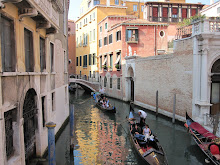
Looking back, I cannot lay out the path I took or find the places that I paused to simply Be. I quickly left the tourists behind. The day was cloudy, so I could not even use the sun to set me in the right direction (north). No matter, my exploration would be purer. I found an art supplies shop in an abandoned campo. I fell into Campo San Margherita and fell out of it. I passed cafes filled with Italian students from Ca'Foscari. The tangle of calli and canals would straighten and retangle as I walked. Olive trees, a church with an elaborate well and a lawn, a marina, a military zone, a pet store, shrines. I passed men unloading oranges from a boat and smelled aromas from the kitchen of an oesteria. Ponte and sorteportego, camponile and canal, twist and turn wove together into the tapestry of the choices of my footfalls.
The most surreal and special moment came when I heard classical music wafting through the calli. It crescendoed in volume as I turned corners and arrived in a secluded campo. The music radiated from a tall church. I approached. The doors were open and covered with red curtains. No one was watching. I peered behind them and saw a symphony orchestra practicing their craft. Here, in a forgotten corner of Venice, the richness of a concert filled my ears as if for me alone. A few Italians casually walked accross the other side of the campo, but it seemed as though I alone could hear the music and see the players. I listened for awhile, then turned to walk away. The music receded; mezzo piano, piano, pianissimo, silence. Tan buildings and lapping of water again filled my senses. It was as though the world of dreams had, for a moment, touched the waking world and now was gone as if it never was.

No comments:
Post a Comment