Gothic style is the physical language of medieval Emplacement. It allows an architectural portrayal of the social, spatial, and ideological Hierarchies present in medieval Christian cosmology and eliminates the residues of a pagan past present in Roman forms. As an expression of society’s beliefs and tastes, Gothic was clearly meant to influence the people who inhabited its spaces and to remind them of their place and duties. Of course, as we have learned from Foucault, such attempts at guiding society along “the narrow path” are never fully successful because the effect of architecture on people depends on the nature of an ever-evolving society. Nevertheless, the philosophical goals of Gothic are certainly worthy of discussion. Gothic style does for space what decoration does for an illuminated manuscript; it embellishes and emphasizes the social and cosmological meaning of a Place.
In his essay “Of Other Spaces”, Foucault describes the medieval conception of space as that of emplacement. By this he means that all spaces have an innate or imbued nature and fit into a hierarchy of places stretching from the depths of Hell to the pinnacles of Heaven. Dante’s “The Divine Comedy” is an example of this conception of space, where all positions and places have some sort of meaning that could ultimately be traced back to God. Because they were the work of a transcendent Author, the Hierarchies of the Universe wove a mysterious and complex tapestry understood fully by God and only dimly by Man. Critically, the spatial, temporal, and social fabric of the universe was intimately connected to that of the moral and anagalogical. Philosophy and human reason could build the foundations of such knowledge, but real Truth was only obtained through Divine Revelation, namely, the Scriptures and the Church.
This idea of Divinely Revealed Emplacement, whether in social structures (ex: divine right) or geography (ex: Jerusalem as center), is well illustrated though the use of Gothic. In “The Nature of Gothic”, Ruskin outlines six traits of the spirit of Gothic: Savageness, Changefulness, Naturalism, Grotesqueness, Rigidity, and Redundancy. All of these are important for the Gothic embellishment of emplacement-space, but, in my opinion, the most critical aspect of Gothic is the underlying trait of Intricacy.
Gothic intricacy takes many forms, and is expressed through all six traits. While not all Gothic architecture exhibits lavish crockets and gargoyles, even a simple ogee-arch window, as Ruskin points out, is infinitely variable and the interplay between the angle and shape of the arch plays with the rest of the building in a way far more complex than that of, say, a lunette window. Gothic architecture celebrates complexity rather than purified simplicity, and this is key to its function as the vehicle of Revealed Emplacement. The medieval order of places and things was rational, as some philosophers had supposed, yet was also something abstruse and fully knowable only through God. The Truth was written in parables, and the intricacy of Gothic was an architectural parable meant to reflect the inherent incomprehensibility of the Divine Plan, yet simultaneously represent it as a beautiful, purposeful thing.
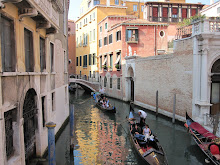
The ease with which Gothic could facilitate complexity not only allowed for the depiction of a parable-laden worldview, but also allowed greater recognition of social differentiation. A round arch with some columns is not terribly expensive and variable; a spider web of ogee arches and quatrefoils is much more so on both accounts. The exponential increase of details that could be added in Gothic set a much steeper curve to distinguish the poor from the well off from the wealthy. The palazzi of the rich (Ca’ d’Orro is a good example) scream out, “This is the space of the rich! It is reserved for your betters!” The homes of the less affluent merely spoke or whispered. Gothic embellishment was a way to set aside spaces for the sacred or powerful in direct proportion to their importance. It was a visual symbol of social and spatial hierarchy.
Closely tied to this use of intricacy is the emphasis of verticality. Horizontality is Earthly (one reason why Frank Lloyd Wright used it to create symbiosis with the landscape) and implies equality and community. Nothing could be further from the goals of Gothic’s creators. Verticality naturally suggests hierarchy because every mountain has a base and peak and every man a head and feet. Gothic verticality aspires to Heaven; in churches it makes one stand in awe of God and recognize one’s own smallness by comparison. This effect is well accomplished by Gothic because ribbed vaults allow ceilings to soar, and the ogee arch inherently emphasizes verticality. In fact, many ogee arches are almost symbols of a pious recognition of Divine Order as they are like praying hands pointing up to God, who is, of course, on top. The apse and ceiling of the Chiesa di Frari are excellent examples of this effect of verticality; the soaring ribs and towering lancet windows humble the viewer as they reach towards Paradise.
Much religious architecture emphasizes the transcendent nature of God, but Gothic architecture also emphasizes the condition of Man. Two of Ruskin’s six traits, Naturalism and the Grotesque, were especially used to remind people of their place in the cosmos. Despite the spiritual aspirations of the church, or the egoism of a homeowner, a person was bound to the material world of nature and the body. One could not escape his Place. Even as the buttresses and windows soared, the lace of tree branches and ugly faces of gargoyles reminded people of their bodily nature and their (temporary) cosmic spot at the sump of a geocentric universe.
It is not immediately apparent how Ruskin’s savageness or changefulness is symbolic of hierarchical emplacement. But as stated with intricacy, the wild, variable nature of Gothic is the language of the parable. It takes the rawness of Man’s rebellious and redemptive relationship with God (and society) and channels it into a praise of order. Perhaps more importantly, savage variation has a panoptic effect that extends the message of the architecture into the imagination. The savage, sometimes grotesque, architecture knows; it knows the darkness of your heart and the secrets you hide, but you do not know it. Its meanings are visible, but maddeningly mysterious. Like God, it can see you always; it watches you from a hidden lancet window or through the eyes of the gargoyle above the crockets on the camponile. It sees your soul.
Much of this panoptic effect is the product of the creative freedom of workers, an aspect of Gothic critical to Ruskin. Far from implying freedom within the medieval worldview, however, creative freedom transformed work into worship or at least the willing embellishment of the existing order. Having the workers put themselves into the architecture extended Emplacement out of the stones and into the lives of the community. An example of this can be found on the capitals of the columns on the Piazza Ducale. Each one is the unique product of the craftsmen, and some even tell stories of their own devising. The work of their minds is set in stone and married to the World Hierarchy, connecting the workers and their families to the burden of the columns, the State.
Redundancy acts as an anchor for flights of savage variation; it is a counterweight to mystery that simplifies God’s Plan and allows regular people to understand and follow. Forms of Gothic are repeated just as axioms of religion (i.e. love thou neighbor, there is but one God, etc) are repeated through the Scriptures to bind theology to a certain skeleton. Certain forms are regularly repeated to emphasize spatial or symbolic importance, for example, a campanile, apse, nave, and transept are the standard backbone of church-space. Within a space, backbone-effect can be accomplished with features like blind arcades, bays, etc. I feel that Italian Gothic is particularly good at achieving this balance between mystery and order, mainly because it is an impure form of Gothic that takes the simple, elegant symmetries of classical architecture and makes them into a rational matrix for the mystic fantasies of Gothic (or Baroque) features. To me, it is a pleasing combination of Reason and Revelation.
Rigidity makes good Gothic great. It pulls the other elements together and gives strength and certainty to the fragile forms created to express medieval Emplacement. It sets the parables and mysteries in stone, makes them taut, and brings force to their subtlety. It allows the stone to be thrown out like a net to entrap light, sky, and space in a web of liturgy. Redundancy becomes clean and the panoptic Eye is equated with God as the power of the building grows. The tight tracery of stonework on the Piazza Ducale adds force to the strange sight of the blocky top story on top of arcades, and seems to say that the Venetian State is supported by the very air and fiber of the world itself.
By using savage variation and rigid redundance, Gothic was able to combine the rational order of the Creator with the mystic Grace of the Savior, and to bolster the position of the powerful by appealing to the clarity of its symbolic forms. Its emphasis of naturalism, verticality, and the grotesque put the viewer in his proper place, spatially or socially, and reinforced the medieval hierarchies. It transformed work into worship and brought sacred Order into the community. In the ornate anthem of the Gothic style, the medieval concept of Emplacement found its fullest architectural expression.

No comments:
Post a Comment