Trains and train stations are fascinating spaces. Like airports, bus stations, and interstate highways, these spaces are fully utilitarian and exist only to be passed through.
In "Of Other Spaces", Foucault speaks of a modern world obsessed with space. We understand our world through spatial concepts like juxtaposition, proximity, and the relationship between "sites", whether they are physical locations, websites, or other abstractions. Everything has to do with the distribution and relationship of sites in space. Time has been annexed by space as a 4th dimension, as testified to by the prevalence of measuring distance with travel time. Foucault mentions how Galileo transformed space from location to motion; this idea was futher elaborated on by Newtonian physics and the increasing pace of modern life. However, I think that he could go farther and say that the ordinary concept of space no longer exists and has been replaced by the idea of Flow, which has evolved from motion-space.
The modern mind envisions space as a network of sites, and, critically, it also envisions time as a network of activity sites. Space and time networks are not independent, but merge together in a sort of hyper-dimensional network. This sort of connection between times and places is as old as human kind, but never before has it reached such complexity and extension as in today's world. Paths through space and time are merged together into the idea of Flow, and the world is increasingly viewed in such a way. Sites become hubs for the crisscrossing of streams; a school is where the quick flow of child-to-school is slowed to child-in-school then leaves as child-from-school, a home is a nexus of bill-flow, child-flow, utility-flow, work-sleep-eat flow, etc. This abstraction of space-time means that actual space and time are increasingly viewed from a utilitarian standpoint. "Places" and "Times" exist solely to be inhabited by Flows. Of course, as Foucault notes, space still very much retains aspects of the sacred: public/private, home as a refuge, cultural space, etc. This schism between the creation of Flow/destruction of space-time and the human need for the sacred causes uneasiness in modern life and allows the existence of a new kind of heterotopia, the heterotopia of limbo.
Limbo heterotopias arise from forms of transportation or places/times assossiated with travel. It is a place where the modern concept of space-time, i.e. Flow, is perfectly actualized. The modern concept of all places and times as Flow is purified and manifested in the moving sidewalk of the airport or the seat of a train. Admitantly, this sort of heterotopia is not as clean cut as a graveyard or a cinema; because the limbo heterotopia is the idealized form of modern space, there is something of a limbo continuum present everywhere. A gas station, a car, a sidewalk has something of the limbo heterotopia to it because limbo is such a part of modern life. Here I will consider the purest forms of Limbo heterotopias, that is, places that exist purely for the existence of Flow. I will stick to the pure forms of the train, airplane, and respective stations.
Because it is a heterotopia of Flow, the Train or Airplane differs in some ways from a spatial heterotopia. Flow is the underlying fabric of modern reality, and transportation is our communion with it. In some cases, such as daily commuting, it loses some of the uniqueness of traditional heterotopias. But then again, even with daily commuting it could be considered a small form of crisis. One's life is put entirely in the hands of the system to go from A to B through nameless places. Entry onto a train is done through the ritual of the ticket purchase, a relatively painless process that nevertheless ensures that the train is entered only in times of necessity. Also, there are only certain times and places where Limbo can be entered due to schedules.
Like all heterotopias, Limbo Heterotopias can change in different societies and situations. At some times, such as during the beginning of air travel, the ride itself was considered a purpose for travel and thus the passenger compartment becomes a Place. A trip on a ship can become a cruise rather than a funnel between A and B. As another trait of a heterotopia, a train, plane, etc juxtaposes all places and flows in a single space because it is outside the normal conception of space and time -inside the airplane, you are just as much at the Louisville airport as the Hong Kong airport as the Atlanta airport because you are detached from reality as a pure manifestation of Flow. You become the pure extension that connects all sites. And as most heterotopias are linked to a moment in time, a limbo heterotopia is itself viewed more as a segment of time than of space (travel time). In keeping with the idea of escaping space-time, often transportation crosses time zones, making an actual time irrelevant (what time is it on a transatlantic flight? Does it even really make sense to ask?)
When one enters a Limbo Heterotopia, he first travels through spaces to arrive at the Gate. While the places needed to get to the Gate are often themselves limbo-like (like the interstate), there is a moment when one must exit a "place" and enter a "non-place". You leave Atlanta to enter the non-place of the airport. The portal between the two may be abrupt or gradual. In the American airport, the final stretch of the Gate is security. Once on the other side, you are really in no-place. The Gate at a European train station is much more gradual, there is a gradient from the ticket offices to the train tracks and one does not really sense the entering of a non-place until the train closes its doors and moves.
Once in motion, the eerie sense of no-place becomes Flow. You are a vector, a momentary point on a route with a certain velocity. Perhaps you see "places" outside a window; they may indeed be places, but you are not in them, you are outside of them entirely because you are mere motion. Time passes, but not really. The time of the train is unconnected to the time of the real world because it is unattached to a place, it is floating. When traveling, time becomes relative to the traveler. One thinks that he has been travelling an hour, an hour has not passed in the world. Objective time becomes subjective time.
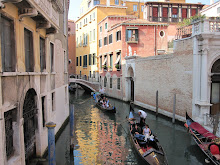
Then the plane lands, the train stops. You claim your luggage and shuffle out into the sunlight. You are in Venice, Verona, Shanghi. You went from a place to a place via an ephemeral conduit. You leave the heterotopia and exit into the "real" world.

Subscribe to:
Post Comments (Atom)
No comments:
Post a Comment