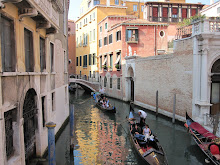
As I awoke, I was reminded of the eternal clash between the expectations and aspirations of mental life with the brutish realities of the physical world. I was sick. When one travels to an exotic, foreign land, he is naturally filled with lofty ideas of sunny skies, perfect schedules, and fantastic experiences. Instead, the reckless physical world inserts surprises: a rainy day, lost baggage, a civil war, or in my case, a very unpleasant germ. Ah, here in the city of ancient plagues I had come down with one of my own.
What it must have been like to have become ill in old Venice I can only imagine. A storm at sea, a knife fight, a crouching tiger -these are all existential threats that one can see and understand. But illness... to have your own body destroy itself from the inside out; that must have been a terror we moderns can scarce imagine. The only protection was to pray, to pray and to wrap yourself in a cloak of superstitions (good and bad air, ring-around-the-rosie, the Evil Eye, etc). Last week, as I was walking through Dorsoduro, I came across a costume hanging outside of a shop that I had seen in a textbook long ago. It was a pitch black cloak with a black wide brimmed hat; beneath the hat was a mask with a long curved bill and spectacles around the eye holes. It was the outfit of a medieval doctor -besides a priest, the only one who would dare to enter the home of a plague-stricken individual. I was shocked to see it and felt disquieted. It was a uniform of ignorance (imagine that a beaked mask can keep you from getting tuberculosis or bubonic plague) and a reminder of just how hopeless the future of a medieval patient must have been.
Luckily, I was not deathly ill, and was able to drag myself out of bed, take some medicine, and hobble over to the vaporetto. How many times in my life would I get to see Padova? I could rest Thursday, and I had probably already contaminated everyone in the group the previous day. After rendezvousing with Dino, we grabbed some refreshment at the train station (I had the most AMAZING frozen coffee drink I've ever tasted) and we boarded the train to Padova. I read a little, listened to music some, and just tried not to be miserable.

Upon leaving the train station, we entered a very modern section of Padova. It could have been any somewhat old city in the USA (modern has a very different meaning after living in Venice). The cars were small, and there were sleek and fast streetcars that zoomed over tracks in the streets (so cool!). Most noticeably, there were multitudes of mopeds, motercycles, and most of all, bicycles. Bikes were everywhere. We crossed a bridge and the low remains of the city walls and entered into the old part of Padova. The streets were reminiscent of Verona, but narrower and twistier. We saw students everywhere, as it is a university town. We crossed th
 rough the ruins of an ancient Roman arena; unlike in Verona, all that remained were some crumbling walls and a few pieces of stone strewn about. It was located in a very pleasant park and we saw college students sitting on benches and sleeping among the ruins of their ancient ancestors. The Scaligheri chapel was built facing into the arena, but we would return to that later.
We continued towards the center of the city where we came upon a piazza dominated by the Basilica of Saint Anthony, an incredible mountain of domes and towering walls. We entered a neighboring chapel and oratory to see works done by Titian and Giotto's proto-Renaissance successor. Both rooms were beautiful. In the chapel, it was interesting to see how Titian tried to blend the style of his three paintings with the pre existing artworks, which looked like picture book illustrations and used pastel-like colors. Even so, it was fascinating to see the little differences that set Titian apart; his use of optical illusion to make the trees and clouds appear real versus the blob-like depictions by the other artist, the many facial expressions and orientations of bodies as opposed to the other artist, etc. The oratory was beautiful and fascinating -the works were clearly a blend of Gothic and Renaissance art and appeared to be experimental. They all contained architecture that the painter was using to figure out perspective and two images of the Nativity were in an identical setting from a slightly different vantage point. He was working on shadowing and realistic action as well, though he does not entirely succeed.


 After this, we reconvened over by the statue of the Venetian hero, the Spotted Cat. The statue is actually extremely important, as it was created by Donatello and was the first
  real equestrian statue since the Fall of Rome. It must have been incredible to unveil the statue -a symbol that medieval Italy had risen to the level of the Romans and could stand with heads held high among their ancestors. We then entered the Basilica of Saint Anthony.
While the cathedral is vast and contains many exquisite works of art, it is very dark. Upon entering, there is an ugly depiction of Madonna and Child with actual crowns attached to their heads. Nearby is a beautiful altar. A painted background depicts light emanating from Heaven illuminating a large gold monstrance. Past this
 is the tomb of St. Anthony. It is a large white stone tomb, and many people passed it, kissed it, and prayed beside it. A stall outside sells special candles that can be donated here as an offering. Near this are three giant gold reliquaries containing such things as his tongue. I do not understand how mere physical vestiges of a great man can have any spiritual significance, but I am not Catholic. Donatello's famous reliefs were undergoing renovation, but I was able to get a peak of them behind the curtain. It was inside this church that I started to feel very ill.
 After this, we headed over to the market in front of the Palace of Law. Most stalls were packing up, and we headed over to a small restaraunt to eat lunch (at about 1 pm). I had a sforino sandwhich and some black grain. The sandwich was good, the grain cosi cosi. I also had some cooked spinach, bread, and a (too-small) mocchiato. The meal was good, and we discussed aspects of the course and whether the course should shift to a full exchange program in Padova.
After this, we went to the Scrovegni Chapel, built by the son of a usurer to atone for his father's sins. The entire interior is covered with frescoes by Giotto. The paintings have been painstakingly restored and we had to reserve a time slot to see them. We arrived at 3 and watched a 15 minute movie about the chapel in a glass room adjoining it. The previous group exited as the movie finished, and we were ushered inside.
T
 he frescoes were astounding. They were in proto-Renaissance style, but Giotto was far ahead of his time and even used paint to create texture, as when halos extended out of the walls. Judas has a black halo. Especially striking was his Last Judgment on the back wall that depicted haloed saints rising and sinners swept away by fire into a Hell filled with blue demons. The time inside was too short to fully appreciate everything, but it was enough to see a good amount. We then spent a little time at the nearby civic museum. I saw some Roman pots and a man buried with a horse, but mostly I rested as I was feeling very ill.
Next we went across town to the Duomo and saw another beautiful proto-Renaissance chapel. The depiction of Christ surrounded by saints on the inner dome was especially beautiful. We then got gelato and walked over to the University of Padova. Along the way, we passed recent graduates, who were dressed up ridiculously for their public mocking, as per tradition. They wear laurals and ridiculous outfits and their most embarrasing moments are posted and spoken aloud for all the campus to know. We could hear the traditional song:
"Dottore, dottore, Dottore del buso del cul. Vaffancul, vaffancul."
Doctor, doctor, you're just a doctor of the a-hole, go f--- off, go f--- off
Doctor, doctor, you're just a doctor of the a-hole, go f--- off, go f--- off
It's actually a very catchy tune and there's often alcohol involved. We waited for a bit inside the new section of the university, listening to the craziness outside. Soon a woman came to take us on a brief tour of the historic sections.
The university of Padova was founded in 1222 and is the second oldest in
 Italy and perhaps all of Europe. It soon became a haven for academic freedom as opposed to the University of Bologna, which was tightly connected to the Church. This freedom was especially well guarded when the infamously secular Venetian Republic took over Padova and, among other things, supplied the university with a steady supply of executed criminals for anatomy studies. Galileo and Copernicus taught here and it was a hotbed for the Renaissance, helping to birth modern science and humanism. We visited the first anatomy theater in existence, a surprisingly small room with tight wooden balconies that could fit 200 people. That, plus the candles, lack of ventalation, formaldyhide, and decomposing body (sometimes in use for a whole week) must have made the place a nightmare to actually be in. The concept of the place was creepy but at the same time ennobling. In the adjacent room we saw early medical experiments, like a brace for paralytics and the first hospital bed. It was in a place like this that people were able to finally escape the bird-faced doctors of superstition and slowly move toward the world of microbes, antibiotics, and MRI. It was the work of these early scientists that, though their concepts seem laughable to the modern mind, took the terror out of my current sickness and replaced it with rational actions, recommendations, and a decent shot at survival.
As an engineering major and an assistant in scientific research at Purdue, this University felt like a site of pilgrimage. Here medicine was slowly pried away from superstition! Here was a place where giants like Galileo and Copernicus taught! A place where the foundations of science were hashed out and basic discoveries were made, and th
 e home of the first woman to ever graduate from a university. How exciting it must have been to first discover the arrangement of organs in the human body, what the heart did, that Jupiter had moons or that the Earth revolved around the sun!
It was dark by this time and the moon was out; I could see the same craters that Galileo had looked at with his telescope 500 years ago and felt a kinship with the scientists of the Renaissance. What they started by looking at the planets with a telescope I am continue by looking at carbon nanotubes with a NIR microscope.