Death in Venice is not a story about travel per se, but rather a story about the personal journey of the illustrious author Gustav von Aschenbach that is intimately and necessarily linked to wider motifs of travel. It is the story of a great man’s undoing as he vacations in Venice seeking relaxation and inspiration. To the romantic, travel is supposed to inspire the traveler and reveal sublimity and authenticity, but in Death in Venice, vacationing in the city of Carnival and decay allows Aschenbach’s darker passions to emerge, ultimately consuming him and the romantic illusions he has created for himself.
The story begins in the mundane home city of Munich, where Aschenbach is filled with wanderlust and cannot overcome his writer’s block. His whole life has been filled with diligent work in the ceaseless pursuit of the perfection of his art, but he needs something more, a vacation. His first inclination is to go to “a tropical quagmire beneath a steaming sky –sultry, luxuriant, and monstrous- a kind of primordial wilderness of islands, marshes, and alluvial channels…”, a place that is a metaphor for the raw passions he has repressed all his life. This is not acceptable to his ego and his sensibility, and he decides on visiting “the friendly South” (ultimately Venice), midway between the cold civilization of Germany and the hot jungles of India. Italy is viewed by the tourist as a land of passion, but also of ancient achievement and Aschenbach hopes to both inspire himself and come to terms with his emotions.
His simplest motive, to relax, is an element of simple tourism that views travel as a leisure activity opposed to work, but his most important motives are romantic. Aschenbach wants to experience the exotic and authentic in order to satisfy his wanderlust, and to find himself in the process. Nevertheless, he engages in many activities that are seem overtly touristic; while in Venice, he spends most of his time on the beach, eats meals at the hotel, and surrounds himself with other tourists. In this, and in initially seeking out the crowded calli of Venice, he engages in what Urrey refers to as the collective touristic gaze, where “other people give atmosphere to a place.” (Urrey, Consuming Places) This is something of an anathema to the romantic tourist, unless the other people are reduced to picturesque objects, something Aschenbach does not shy from doing when he describes the other occupants of his hotel.
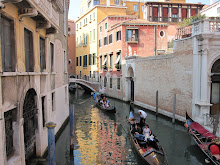
And yet, in many ways, Aschenbach does in fact see Venice through the eyes of a genuine romantic anti-tourist. He frequently surrounds himself with Buzard’s four elements of authenticity: stillness, saturation, picturesqueness, and non-utility. A good example of this is his shady gondola ride to the Lido. Aschenbach is not riding a vaporetto, the modern solution to travel in Venice, but rather the antiquated and iconic gondola, which occupies a place more cultural than practical. He is removed from the world of duties, honors, fans, and is alone, apart from the gondolier. In his solitude, he is surrounded by the lagoon, the sky, and the fantasy land of Venice, all incredibly picturesque. He hears only the lap of the gentle waves and the swish of the oar as it embraces the water; he immerses himself in the richness of his environment and is lost in the dripping romance of the place.
Further than this, Aschenbach behaves like a true Romantic because he wants to experience not only the Authentic, but also the Sublime. That is his reason for taking up residence next to the Lido rather than in the heart of Venice; he is not as interested in knowing the innermost being of a particular place, Venice, as in getting a glimpse of something universal by communing with the ocean and the beach. The Romantic seeks out the majestic, the superhuman, in his search for the sublime, and the ocean is just such an object. Aschenbach seeks sublimity through isolation (although he is surrounded by people, he is alone in the anonymity of the crowd, whether in Venice or in his hotel of strangers) and by permitting himself to see and feel. In Germany, he tried to find sublimity through intellect, but in Venice he aims to do so through emotion and simply existing. “Solitude begets originality, bold and disconcerting beauty, poetry. But solitude can also beget perversity, disparity, the absurd, and the forbidden.”
Aschenbach finds the sublime in the form of a young boy. Tadzio appears to him as aesthetic perfection, as beauty itself. Aschenbach is amazed, and begins to observe the boy as he plays on the beach, as he eats, as he travels with his family in the city. He resists his desire to see Tadzio at first, then rationalizes it as a natural desire for the Aesthetic. Aschenbach is happy as he immerses himself more and more fully in the sunny, peaceful days at the beach, the picturesque strolls through Venice, and the beauty of Tadzio’s body and behavior. Aschenbach is caught in the ultimately illusionary nature of the romantic anti-tourist’s understanding of places and things.
Even from the beginning, multiple cracks were apparent in his happy simulacra of a fairy tale Venice and platonic beauty incarnate. During his idyllic gondola ride, Aschenbach is confronted with the fact that his gondolier is in fact trying to rob him of money by taking him all the way to the Lido instead of to San Marco as he requested. Aschenbach is, of course, upset, but does not want to break his fragile dream and allows himself slip into indifference. He is able to continue maintaining his dream by living at a hotel and on the beach, separating himself from unpleasant realities like poverty or normal decorum, and by keeping Tadzio at a safe distance. He later realizes Venice is making him ill, but does not want to leave his illusion and is delighted when actual events force him to remain. But as the story progresses, Ashenbach finds reality harder and harder to avoid. He hears coughing and smells disinfectant as he follows Tadzio around the magical city. He overhears whispers as he eats his breakfast, catches glimpses of disquieting shadows, and encounters ominous characters. Meanwhile, he gives himself over to his passions more and more, ever justifying himself with aesthetics or philosophy.
Finally, Ashenbach comes face to face with Reality when the English official tells him about the plague ravaging Venice, appropriately originating in the jungles of the Ganges delta, symbolizing the swamps of Aschenbach’s passions. The danger, both physical and moral, is undeniable. At this pivotal moment, Aschenbach decides to fully throw himself after his shattered illusion, abandoning all dignity and refusing to warn Tadzio’s family about the plague because of his own selfish desires. Embracing illusion, he dyes his hair and puts on makeup, waiting lustfully for Tadzio as he dies from the disease present in a harsh and inescapable reality.
Travel, as viewed by the romantics, is meant to inspire a person and to foster communion with the authentic and the sublime. It is meant to feed the soul. In Death in Venice, travel takes communion with the sublime too far; it allows the constrained passions of Aschenbach to rise up and, with the help of sweet and sickly Venice, gain control of him, leading him to his ultimate ruin.

No comments:
Post a Comment