Photodocumentary of My Experience of the Space of the Route to the Rialto
 The path from San Zaccaria to the Rialto begins here at the boat stop. This is an endpoint to that path, and as it is a vaporetto stop, it also functions as a node between San Zaccaria, San Servolo, San Lazzero, and all the stops of the #2
 This Fondamenta is a path, one of the more important ones in the city. It connects Piazza San Marco in the west to Sant'Elena in the east, although its endpoints are not as important as its secondary function. That is to form a boundary between Venice and the Lagoon, and to provide open space for the city, thus separating the Interior of the calli from the Exterior of sea and sky.
 This statue is a critical and prominent landmark. It marks the spot after which I look for the sotoportego for the next leg of the trip (shown below)

 This police station is a landmark
 Another landmark prominent in my mind
 A very large landmark. The cluster of these last few landmarks suggest I am approaching a node; this is true, but it is interesting that the node is not the large campo in front of the church, but rather the crossing of paths a little further on, shown below.
 Below is the path, devoid of landmarks. It is a simple line and route, and in such spaces simply following the walls suffices for navigation
 Of course no one goes very far in Venice like that. This bridge is located at a slight knot in the path, and is thus a prominent landmark. Although the direction of the path does not significantly change here, the kink causes heightened alertness and thus additional importance for landmarks.

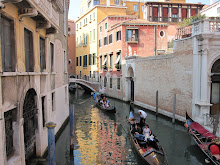
This canal functions both as a landmark, and as an edge dividing legs of the path.
 This capitello, the "Shrine to the Unknown Saint", marks the beginning of the section heading to the boatstop
 This gondola workshop is a unique landmark along the way. This leg of the trip is especially windy, so it remains prominent
 Sotoportego through which the path goes
 This alley is around two corners from the sotoportego: its narrowness is a calming reminder that I am going the right way. There is a small shine in the courtyard through the door, a further reminder I am on the right path
 A twist in the path that demands attention
 The landmark and edge of the bridge, leaving the 2nd leg of the path and entering the node of Campo Santa Maria Formosa

The Node of Santa Maria Formosa The body of the church is a landmark signifying the node
 The body of the church is a landmark signifying the node
 The camponile is an even more promenent landmark, and its base is a landmark for a set of paths that leave the node.

The gondoliers here act as a landmark that marks the entrance of the path back to the boat stop. This capitello is the landmark signifying the beginning of the path to Giovanni e Paolo
 This capitello is the landmark signifying the beginning of the path to Giovanni e Paolo
 This capitello and bridge are landmarks for the path going to Strada Nova
 These drinking lions are sweet landmarks
 This pizzeria is a landmark for the path to the Rialto
 The canal that is both a landmark for the path to the Rialto and the edge dividing the node of Campo Santa Maria Formosa from the district of San Leo
 The landmark of the wine shop means I am close to making a right turn
 This is San Leo -a fairly straight and strong path. Landmarks here are not very important, as I simply follow the path.
 This landmark, however, is very important because it means the gelataria is just ahead.
 This church is a landmark letting me know I am still on the right track
 A little twist in the path. The distinctive bridge and tunnel form a strong landmark that establishes confidence in moving to the right.
 Though I am officially entering a separate sestiere, it does not affect my navigation or sense of space.
 There is a tangled sotoportego section where I am especially attuned to landmarks, such as the wine bottles in that window.

The node of Campo San Barthalemeo
This statue is a landmark for the node
This bright orange money change shop is the landmark signifying the beginning of the path to Strada Nova.
The final leg to the Rialto is signified by the profusion of venders present here. The stairs of the Rialto are just visible in this photograph

This statue is a landmark for the node

This bright orange money change shop is the landmark signifying the beginning of the path to Strada Nova.

The final leg to the Rialto is signified by the profusion of venders present here. The stairs of the Rialto are just visible in this photograph


This comment has been removed by the author.
ReplyDeleteI find this a very interesting and thought-provoking blog. It has set me thinking in new ways about subjects that have intrigued me for years. Thank you very much!
ReplyDelete