Introduction
This portfolio consists of four parts: a major essay on the nature of Venetian space, a minor essay on the heterotopia of the Venetian church, a collage and discussion of the symbols and motifs that unify the city, and a work that examines the individual interpretation of Lynch's elements, consisting of maps drawn by my classmates and a photodocumentary of my route to the Rialto. The main essay explores the many aspects of the spaces of Venice and how the experience of existing in Venetian space is composed of various elements. The other portfolio components are elaborations on themes mentioned briefly in the main paper but better explored elsewhere and through other means. The division of the portfolio into three parts on the blog was done solely to facilitate posting.
The Fabric of Venetian Space
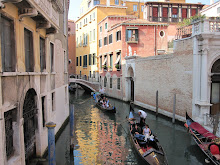
What is the nature of Venetian space, and of motion through it and existence in it? No city in the world is easier to get lost in, and no urban environment is as densely filled with myth, confusion, and picturesque tranquility. It is an aquatic medieval labyrinth, a city honeycombed with countless manifestations and combinations of calli, bridges, sotoportegi, canals, campi, docks, dead ends, and more. Beyond the physical complexity of these spaces, they are also immensely complex in history, symbol, and Romantic connotations. It is the effect of all this, of the physical, the narrative, the Romantic, and the myriad symbolic details that creates the extraordinary spaces of the city of Venice.
Instinctually, the most striking thing about Venetian space is how utterly foreign it is to a typical urban environment. It has no cars, no real streets, no rational urban planning. It is a city filled with and surrounded by water, a medieval maze of alleys, bridges, and canals that seem to defy understanding; it is the very antithesis to the dreams of Le Corbusier. It is this alien nature that makes the study of Venetian space so particularly intriguing, and makes the application of Kevin Lynch’s understanding of urban space so fascinating. Lynch breaks down a person’s experience of urban space into five elements: paths, edges, districts, nodes, and landmarks1. In Venice, these elements are very fluid and interact in complex ways.
Lynch’s Elements in the City as a Whole
At the highest level, the city of Venice is enclosed by a formidable edge: the shore of the Lagoon. The water of the Lagoon is an undeniable reality that forces the pedestrian to stop and denies the city any significant sprawl. As an edge, the shoreline is remarkably clean cut because it is the transition from crowded urban space to the flat, open space of the water. To the pedestrian, this space functions much as a window does; it extends the dimensions of the space one inhabits (in this case, a fondamenta, dock, etc) yet its space is fundamentally inaccessible. The space of the Lagoon is the space of the sky. It is a vastness instead of an inhabitable space, and its presence simply amplifies the size of the inhabitable space next to it.
Additionally, Lagoon space is a perfect example of a critical fact of Venetian space: Venice is actually two combined cities, the city of the pedestrian and of the boat. The pedestrian experiences the space of the Lagoon as a vast inaccessible openness, but the experience in the boat is different because the boat can actually inhabit it. What is inaccessible to the pedestrian is the city of the boat, and what is inaccessible to the boat is the city of the pedestrian. The paths and nodes of boats and pedestrians are thus fundamentally different, but they may share the same districts and landmarks, and they always share the shoreline as an edge. To the boat, Lagoon space at first glance appears to be a space unimagined by Lynch, a space that offers infinite paths and the vastness of the sky. However, this is not the case. While that sort of space may exist in the Adriatic, it does not exist in the treacherously shallow Lagoon. For the boat, the Lagoon is a series of road-like canals and thus a series of bona-fide paths marked by the landmarks of islands and poles. Some of these canals are very large, like the Guidecca Canal, and may function more like districts than set paths.
The strong Edge of the Lagoon shoreline does not proscribe an ultimate boundary of Venice as Lake Michigan does for Chicago, but mainly functions to split the city into several incredibly strong districts –the main islands, the Guidecca, the Lido, Murano, San Servolo, etc. Certain unique island traits, such as cars on the Lido or the colored houses of Burano, serve to further strengthen the district nature of these island districts. While this creation of districts is strong for both boats and pedestrians, it takes on an additional flavor for boats because most of the islands have canals and are thus separate districts containing paths, but each island also serves as a sort of boundary dividing regions of the Lagoon from each other (the Guidecca Canal, the South Lagoon, the North Lagoon, the Adriatic Sea, etc).
The Grand Canal is another very strong edge for the pedestrian, splitting the main city into two rough districts. This effect is much stronger than with any other canal because, besides the fact that it is huge, famous, and highly decorated, there are only a limited number of ways to cross the Grand Canal. The pedestrian who wants to go between these districts must explicitly plan to take advantage of one of the three bridges or the traghetti. The Canal di San Chiara (dividing Piazzale Roma from Ferrovia) and the Canale di Scomenzera (dividing Tronchetto and the cruise ship area from the rest of the city) also force this kind of planning and district making.
To the boat, however, the Grand Canal is not just a path but The Path, the Axis of Venice. It is chock full of landmarks (unique palazzi, gardens, the Rialto, etc) and connects 16 station nodes to each other. For the pedestrian on a vaporetto, it is sort of a linear node that connects the entire city through these stations. Its function as Axis of the city is also clear to regular pedestrians, but it is not as strong as for boats or people on vaporetti for three probable reasons. First, pedestrians cannot walk along it or experience it as a main thoroughfare. Two, the calli and campi around the Grand Canal don’t orient themselves off of it or provide a good view of it from far away. You must almost be upon the Grand Canal to know it is there. Third, the Grand Canal is highly curved, and simply reaching the canal tells you nothing of your north-south orientation unless you know a good deal about where you are. Despite these limitations that reduce its importance to pedestrians, the Grand Canal is still very influential for Venetian pedestrian space because it splits the main city into more manageable halves and gives at least a rough idea of where one is in relation to the extreme ends of the city, as it is always sort of in the middle of the city.
The great nodes of Venice are Piazzale Roma/Ferrovia, Piazza San Marco, and the Rialto. The node of Piazzale Roma/Ferrovia is especially interesting because it acts as the umbilical cord of Venice, connecting it to the rest of the world through the Ponte Della Liberta. This node is a strange buffer zone inhabited by cars, trains, and vaporetti, and is seemingly a place that exists solely for crossing between Venice and the world. Though it is a node, it is also sort of an edge. Contrast this with the nexus of Piazza San Marco, a place strongly seen as a destination in and of itself and a sort of Venetian Umbilicus Urbis from which all Venetian spaces radiate. Not in a literal sense, of course, but in a way that reflects its status as the symbolic center of Venice as well as a great node. Lynch would call this place a Core. In light of the functional dichotomy of these two great nodes, it is fitting that the orientation of the city itself seems to be polarized between these nodes on opposite ends of the Grand Canal. All paths and vaporetto lines seem to lead to Piazzale Roma/Ferrovia OR to Piazza San Marco.
Directly between these two nodes is the other great node of the city, the Rialto. Almost perfectly in the center of the main city, the Rialto is the functional center of the city. This node functions the most like a regular node; it is the meeting place of many paths and maintains this transitional nature.
The strongest paths in the city are the three long Fondamente and the Strada Nova (including the streets it becomes). Via Garibaldi is also a path, but is somewhat less important than these others as it does not connect nodes or serve an opening function. The Fondemente (The Zattere in Dorsoduro, Fondamenta Nova in Castello, and the fondamente bordering the southern Lagoon in Castello) are interesting as paths, because they also act almost as Edges, because they follow the shore of the Lagoon. Strada Nova connects the nodes of Ferrovia and the Rialto, but the Fondamente serve another role besides connecting places. Unlike most American urban environments, Venice has a very weak sense of inside versus outside. Most paths through the city go through sotoportegi and are narrow, almost walled in, and thus are in sort of a limbo between being outdoors and indoors. The city is claustrophobic the fondamente serve an important purpose by connecting the pedestrian to the open space of the Lagoon and thus create a strong sense of being “outside”. It reorients the confusing claustrophobia of the calli in a satisfying way; the whole tangle of calli becomes the Interior, and the fondamente and wide open Lagoon the Exterior. The local paradox of inside versus outside is thus resolved on a city-wide level. The campi and Grand Canal also serve this function, but they are all ultimately enclosed by the tangle of buildings and paths and do not provide as much breathing room as the fondamente do.
Lynch’s Elements inside the Maze
To leave the view of the city from the tower and to apply Lynch’s elements to its honeycomb complexity of the calli and campi is to try to make sense of an M.C. Escher space. The elements previously discussed are critical to the concept of Venetian space as a whole, but they do not serve well to integrate the city together in the way Haussmann’s Parisian boulevards would do. That task is accomplished primarily in the realm of symbols, narrative, and Romanticism and will be discussed elsewhere.
In the wilds of the Venetian Interior, all five of Lynch’s elements –paths, edges, nodes, districts, and landmarks appear with frequent regularity, although landmarks are probably the most common. The elements shift and convert between themselves, depending on the individual and situation. As an example, consider the canal. To the pedestrian in a dead end calle, the canal he finds at the end is an annoying edge. Perhaps a few meters away, though, is a bridge where one’s path can cross over the waterway. The pedestrian here may view the same canal as a landmark along the path, while a boat sees the canal as the path and the overarching pedestrian path of the bridge as the landmark. The pedestrian who looks into the route of the canal sees it ultimately curve away behind buildings –where it goes, he does not know- and it creates additional inaccessible “window” space. A gondolier who looks up at the calli disappearing into the tangle of buildings may do the same thing. It is in the tangle of calli and canals that the interplay between the worlds of the pedestrian and the boat creates its most complex intricacies.
The calli wind, terminate, fork, switch back on themselves, switch directions, and confound the expectations of the pedestrian, chopping any path through the city into smaller segments. Indeed, the labyrinthine nature of the city shrinks Lynch’s elements down. Distances and urban features that could be deemed picturesque but superfluous in a rational city become critical for navigation. Paths that are convoluted must be broken down into short stretches thoroughly marked with little landmarks; in fact, a path may be nothing more than a series of landmarks. Many things can function as landmarks: a particular bridge, a grotesque doorknob, a shrine, a statue, items in a shop window, a water fountain, a church, a canal, an odd lamp post, a set of Gothic windows, and almost anything else. Luckily, Venice is imbued with an abundance of such features, allowing the creation of a rich mental map of landmarks and contorted paths that could not exist in a mazelike but homogeneous city. Most landmarks are small or localized; the great exceptions to this are the campanili. I myself have navigated using the campanile of the Frari, and the same can theoretically be done with any other campanile in the city. They provide a sense of direction that is otherwise totally lost in the perpetually winding alleys; however, their use as landmarks is limited because they are usually hidden behind the bulk of buildings.
Nodes in Venice take on a newfound importance with the tangle of paths. Most nodes are synonymous with campi, those brief glimpses of openness and clarity, although there are other types, notably the vaporetto stops. These stations can be considered nodes because they are hubs of transportation. They connect a particular region of the city with all the other regions in a way that is fundamentally easier to understand than through the use of Venetian paths. They are not like bus stops. In an American city, a bus stop is simply a point along a path; the route of the path is the same as that of the bus. A better analogy would be a metro stop; it connects many places in the city together through space not usable to the pedestrian, to whom the whole trip from station to station is sort of a point along his path. Nodes are prevalent in Venice, and going places in Venice often seems like jumping from node to node like stepping stones, through sequences of landmarks. Intersections of small paths thus become small nodes, heavily marked with landmarks.
As Lynchian districts, the sestieri function rather weakly. None is very visually distinct from the others (with the exception of the part of Canneregio that has parallel canals, or the touristy parts of San Marco) and their borders are often very fuzzy and arbitrary. However, knowledge of one’s sesteire helps in getting an idea of location in the city as a whole, although not in a local sense. The strongest districts in the city are the previously mentioned islands and the east-west sides of the Grand Canal. The pedestrian may create many districts in his mind corresponding to certain groupings of paths or landmarks; for example, I view a nameless campo at the end of the Strada Nova as the meeting point of three districts: Strada Nova, Santa Maria Formosa, and the Rialto. Another district is the cluster of alleys around Via Garibaldi. Venetian districts can be of any size, from a small region between canals on a path to an entire half of the city. Typically, districts seem to either be areas following a particular theme, such as the tourist shops around San Marco or the Rialto, or a path and its side branches, as with the Strada Nova. Indecipherable lumps of city can also be cobbled into districts, although their edges are not very distinct. A personal example of this is the mess between San Lorenzo and the Arsenale. Canals are useful as official borders between districts, although most any edge or prominent landmark will work.
The Narrative Dimension of Venetian Space
Lynch’s elements form an organizational web that fulfills the basic human need for order and understanding in one’s environment, but it is not the only organizational force at work in Venetian space. Lynch’s elements exist apart from time and the whole web of Lynchian relationships can be viewed at once. Some parts of the web are a series of landmarks, etc along a particular vector, but that sequence is relational rather than temporal. Time is an undeniable fact of human life and is intimately connected with how we experience space. As space is organized by Lynchian elements, time is organized by the narrative elements. As Hayden White says in “The Value of Narrative in the Representation of Reality”2, narrative is central to culture and is at the very heart of our understanding of the world. He quotes Roland Barthes to say that it is “simply there, like life itself…international, transhistorical, transcultural.” Narrative takes events in time and connects them with its elements of cause & effect, sequence, purpose, etc. When White compares the stark annals of the Middle Ages with the more descriptive later chronicles and, implicitly, modern narrative histories, the reader is taken aback by the strangeness, banality, and directionlessness of the annals. It is like existing in a space with no Lynchian elements but only address numbers; the essence of the thing is lost. Narrative not only organizes events in time (the sole organization of the annals), but gives events additional relationships to each other that frequently connect to cultural systems or values. The long history of Venice has made many spaces settings for various kinds of narratives that connect them to the events, cultural systems, and the passing of times, strengthening their individual character and connecting them in complex webs.
As a testament to the power of narratives to enrich a space and to connect it with people, events, and ideas, read the following:
There is a sotoportego back behind the Chiesa di San Lorenzo, down a canal and over a bridge that is filled entirely with wallpaper and with two stone shrines. It is said that during the plague of 1680, while the Venetian Republic was drawing up plans for the Salute, an old woman named Giovanna told her fearful neighbors to put their faith in the Madonna to protect them from the ravages of the disease. She then drew a picture of the Virgin surrounded by saints in the sotoportego to keep them safe. The religious power of those images kept the sickness from entering the neighborhood, and nobody became ill. In gratitude to Mary, the people of the neighborhood turned the sotoportego into a shrine and maintain it to this day.3
Such narratives have a powerful effect on spaces. Instead of being simply an ornate tunnel, the Sotoportego di Corte Nova is a place that speaks to the power of faith and the idiosyncrasies of those who once walked through it. Through narrative, the tunnel is connected to abstract ideas of faith, salvation, protection, fear, etc, and to lost times, people, and societies. Narratives turn spaces into places, taking a spot that was previously only a site on a Lynchian web and giving it a unique additional set of relationships that sets it apart from the others. It defies the utilitarian view of space and brings us back, if only partially, to the more satisfying medieval paradigm of Emplacement. Every place has a meaning and cannot be interchanged with any other. This transformation of utilitarian space into special place through narrative is enhanced in Venice because the physical uniqueness of most spaces already helps differentiate them into Places and because Venice has an enormous arsenal of narratives at its disposal, including those involving the observer of the space.
Even in spaces with no known stories behind them or in them, narrative can find a hold due to the general history of the city and the strength of the myths surrounding it. A person who has read the memoirs of Cassanova may see a bridge that reminds him of one of the famous libertine’s exploits, informally connecting a floating narrative with a concrete spot and thus expanding the nature of the space. One can connect a palazzo with a Doge, or a deserted campo with the stalking Aschenbach. The connection doesn’t need to be this explicit, however, for a space to reap the rewards of narrative. The very presence of floating narratives, that is, narratives with a generic Venetian setting, allows an aura of “forgotten” narratives to fill the city. These myths and stories happen anywhere and everywhere, spreading throughout the city like a fog that coats the surfaces of calli with the dew of unfocused stories.
Floating narratives do not even need to be known. Many details of the city, such as a particular inscription on a building or a mysterious tondo obviously have stories behind them, though they are unknown and may remain so forever. They too give narratives to their spaces and to the city, though they have been reduced more to mysterious moods and auras than stories proper. It is these forgotten, floating narratives that create the aura of history. John Ruskin describes this aura when he writes, “For, indeed, the greatest glory of a building is not in its stones or in its gold. Its glory is in its Age, and in that deep sense of voicefulness, of stern watching, of mysterious sympathy, nay, even of approval or condemnation that we feel in walls that have long been washed by passing waves of humanity.”4 Faded narratives are history, and history makes spaces come to life.
This feeling of history, of subconscious and forgotten narratives, is intimately connected to Romantic ideas about Authenticity and the Myth of Venice. It is important to stress here that all these components of Venetian space –physical, narrative, and Romantic- are ultimately dependent upon the person who exists in the space. Without observation, space is space, and the nature of the observer is critical to the concept of space that will emerge. The physical and narrative aspects of space are experienced universally and, when applied to Venice, it is logical to assume they will be more pronounced for virtually anyone because Venice is a more intense space on both accounts. However, when one discusses the Romantic component (necessary in virtually any discussion of Venice), it is vital that its fundamental subjectivity be addressed. This component is especially subjective because it deals with aesthetics and beauty, concepts for which people are eternally in disagreement, and because it involves 19th century thought and “the touristic gaze”. A Venetian will not see all the Romantic connotations of a bridge over a canal because, to him, it is ordinary. The tourist will see pavement as picturesque simply because it is Venetian and thus subject to the aura of the Myth of Venice. As a long-term visitor, I the author am between the extremes of tourist and local and can perhaps treat this aspect of Venetian space even-handedly.
The Romantic Dimension of Venetian Space
The fog of narrative that covers Venice is very closely linked to that other urban fog, the Myth of Venice. This aura of The Myth feeds on the aura of narrative; it distills the surrounding history, as well as culture and society, into an “essence” of the city. It does not connect a space to webs of people or events, but to abstract ideas, images, or moods. Like narrative, its general aura fills the entire city but unlike the aura of narrative, it does not come into focus in a space through the learning or experience of a new story, but rather through the manifestation of Buzard’s four elements of Authenticity: stillness, non-utility, saturation, and picturesqueness.5
How does a space manifest these criteria? Stillness is inversely proportional to the amount of people and noise present; therefore it is plausible that the places that manifest this most are the most removed from the main nodes and paths of the physical space, such as dead ends. This element is also connected to historicity, which is practically omnipresent in the city except in places like Tronchetto or the Lido. Non-utility, or unreality, is reflected in Venetian space by how at odds it is with modern (non-Venetian) systems of living. Canals, retrofitting, winding narrow alleys, closed down wells, rusting ironwork, jumbled buildings, and empty moorings for gondolas all produce this element. Things like vaporetti or modern stores along the Strada Nova do not reflect this because they represent a functioning Venetian society, taking Venice out of a dream world into a world where people operate as they do universally. Perhaps most importantly for the criteria of non-utility, space must be as complex as possible. The modern world is about straight lines and broad streets; narrow labyrinthine alleys that dart every which way over bridges and through tunnels remove the observer as far away from “everyday life” as possible. The calli by the Arsenale are more dreamlike than the blocks of houses on Sant’Elena. Saturation refers to density of stimuli, whether aesthetic, symbolic, or historical and is often strongest where narratives are the most abundant. It is a synonym for the aura of narrative and Myth that permeates the city. Lastly, picturesqueness is the most subjective of these criteria and is a sort of aesthetically pleasing combination of the other elements and is usually found where they are.
By exhibiting these traits, a space can become an embodiment of the Venetian Myth. A Romantic space is thus connected to a whole set of ideas about the real Venice, and the space itself feels more “real” than it would without these traits. Of course, this applies mainly to the tourist inhabiting the space. To the Venetian, Authenticity to the Myth is not relevant in experiencing the space. Aesthetics, however, are. Some of what has been said of Authenticity is also applicable in a general aesthetic sense, but beauty is much broader than the tourist makes it out and cannot be readily explained in any reasonable length of time. Suffice it to say that beauty greatly enhances the nature of a space, while ugliness conversely debases it. The aesthetics of a place put a positive or negative value on the space, though often this is a subtle effect.
Other Dimensions of Venetian Space
Also critical in the understanding of Venetian spaces is the social dimension. It is not enough for a space to connect with narratives in the past and with ideas and other spaces; a space must also connect with the present and with real living people and their practices. The way people interact with particular spaces can leave an impression of life, death, or un-life. Consider Campo di Santa Maria Formosa. This campo is filled with cafes and shops. There are several gondoliers here, and usually several groups of Venetians talking or walking through the campo. The priest leaves toys out for the neighborhood children, who ride scooters and play soccer in the late afternoon. It is a space that feels alive. The same could be said of Via Garibaldi, or other places with lots of people and quotidian events, although living spaces do not need to be busy spaces. A residential calle that sees people come and go only a few times a day is still a living space; you can sense people living behind the walls and that the space is used.
Contrast this with Campo di San Lorenzo. This space is dominated by an abandoned, decaying church and surrounded by buildings with shaded windows. The well, focus of most any campo, is desecrated with graffiti. Weeds grow through the cracks of steps covered in bird droppings. The campo is usually empty, except for pigeons and the feral cats that have made it their home. It is a dead place, and any analysis of this space would be blind if it did not see this.
There are also places that have a sort of un-life, utilitarian spaces and touristy spaces. As an example of utilitarian space, consider Tronchetto. This is a place that is often filled with people, as it is the great parking lot of Venice. There are many tourist stalls here that sell their wares, and there are benches and places to buy food. But even though this space has people in it, it is not really alive because the people are only passing through it. It is a space that exists only for the flow of people in and out of Venice, and for the services that have attached themselves to that flow like barnacles. As an example of touristy space, consider the many tourist shops around Piazza San Marco. They are quite real as they are places where people work (and maybe live), but they are at the same time unreal because they exist as sort of a simulacrum of other spaces and of the Myth of Venice. They do not have life as other spaces do.
The symbolic aspect of Venetian spaces is also important. For example, a space that contains a relief of the Lion of Venice is instantly connected to everything that figure represents; the space is made more majestic and at the same time the observer of the space feels the panoptic gaze of the State, embodied as the symbol. The many capitelli (street shines) that are spread throughout the city bring the sacred out into the secular spaces of the working and living city. They remind the observer of the tenants of religion and also create a feeling of panopticism in their presence, like God is watching. Because Venice is so physically fragmented and lacks Lynchian elements that strongly impart a sense of unity to the city, these symbols function as a way of unifying the city in the abstract realm. This is explained though a collage and discussion present in this portfolio. The special spaces of heterotopias are naturally also present in the city, and a discussion of one important Venetian heterotopia, the church, is also included in this portfolio.
The perception of space is ultimately a personal experience, and as such, I will close with my own experience of the spaces of Venice. As I have adapted to Venice, my experience of spaces in the city has changed. At first, space was experienced primarily through the Romantic element and through an astounded view of the physical space. As I got to know the city better, Lynch’s elements began to assert themselves strongly and narrative replaced Romanticism as the primary connotation of many spaces. Authenticity to the Myth of Venice became less important as I began to identify places as unique by relating them to other locations and to specific narratives. I began to see the importance of social and symbolic forces in the city, and some of the most distinctive places in the city, such as San Lorenzo, are due to these factors. I think that, if I stayed longer, Lynch’s elements and the social dimension would take on a stronger and stronger role and the elements of narrative and Romanticism would be greatly reduced, although still much higher than in American cities. In general, my perceptions of space would gradually fade into the background as I no longer pay attention to it; this has already happened on some of my most traveled routes.
But even on the most traveled paths, one can always reawaken himself to the richness of the space he moves through, especially when that space is Venice. Lynch’s elements spread before him like a tapestry, and the intersecting worlds of history, myth, and society feed the mind and the soul. Venetian space is fascinating space, and the interplay of physical form, narratives, Romanticism, society, and symbolism creates a complex and ever changing environment in which to exist.
Bibliography
1. Lynch, Kevin. “Images of the City”
2. White, Hayden. The Content of the Form. Baltimore and London: John Hopkins University Press, 1987, Chapter 1: “Narrative Discourse and the Representation of Reality”
3. Blog Post, Ann, “Sotoportego di Corte Nova shrine”, http://www.slowtrav.com/blog/annienc/street_shrines/
4. John Ruskin, “The Seven Lamps of Memory” The Genius of John Ruskin: Selections from his Works. Ed. John D. Rosenberg. Charlottesville and London: University of Virginia Press, 1998
5. Buzard, James. The Beaten Track: European Tourism, Literature, and Ways to “Culture” 1800-1918. Oxford: Oxford UP, 1993
Discussions from the course “The Wonders of Venice”, Purdue University, Fall 2009
The Sacred Space of the Church
Like islands in a secular sea, the churches of Venice are sacred spaces distinct from their surroundings, spiritual bastions in the mundane chaos of the everyday. Through their ancient doors, one enters a world where silence and solemnity dominate and where the outside laws of physics, economics, and pragmatism are replaced by the order of religion. This existential system is reflected in the symbolism of the architecture, the art and decorations, and the practices that occur within the church. From the large and magnificent to the small and plain, the churches of Venice present an interesting sort of heterotopia1.
A church is a special kind of heterotopia because, in Venice, it is so omnipresent. Churches are present in the heart of the city, in its campi, and were until recently a huge part of daily life and thus in some ways, of ordinary space. Ordinarily, a heterotopia is somewhat separated from everyday life, but I think it is still clear to most people who enter a Venetian church that church space is very different from most other spaces in the city.
Fundamentally, church space is sacred space. Unlike the sacred space emanating from the capitelli, church space is explicitly divided from secular space. A street shrine emanates spirituality into the profane world but is itself tainted by its presence there. For instance, it is subject to the weather, to dirt, and to such ignoble things as rat poison. A church keeps its sacred space pure, and in doing this, preserves its primary function –to reveal and instruct the religious order of things.
As Yi Fu Tuan states in “Architecture and Awareness”2, churches (particularly cathedrals) appeal to the inhabitant of the space in several ways. There is first the subconscious aura of the space, the vague feeling created by the sweep of the architecture. In Venice, most churches occupy central and important locations in campi. They are often either large and imposing or else have a richly decorated façade. Both of these styles emphasize the importance of religion in the order of things. Once the space is entered, one is presented with a vast internal chamber, something unusual in claustrophobic Venice, and often with rich decoration to reflect the glory of God and the church. There is then explicit teaching and symbols: crosses, confessionals, holy water, incense, and pedagogical artworks. The sacred, interior space of a Venetian church presents a perfection of the world; it is an image of the relationship between God, Man, and the World, and of the purposes that explain the confusion of the world outside the doors. This is especially clear in the design of certain medieval churches. Many medieval churches were oriented with the altar to the east; the worshipper would enter from the west where the sun dies daily, for to enter the church is to leave Death behind and to find new Life through Christ. The altar is in the east, birthplace of the sun and also the approximate direction of Jerusalem from Italy. The Christian Church is known as the body of Christ, and nowhere is this more evident than in the design of a Latin Cross Church. The congregation in the nave and transepts are where Christ’s legs, torso, and arms would be on the Cross, and the chancel contains the Altar and the Sacrament, the head of Christ. Artworks are in dialogue with each other on the aspects of the Christian life and of the nature of existence. Peacocks, holy water, and crucifixes all attest to fundamental aspects of the religious bedrock of the world.
So there are two important aspects of any heterotopia it juxtaposes within it incompatible places (heaven and earth, parable and reality) and functions in relation to all spaces (it unifies and explains them). A heterotopia is also adaptable, and this is true for the Venetian churches. An example of this is the disappearance of the rood screen or iconostasis. This barrier originally symbolized the barrier between heaven, represented by the chancel, and the earth, represented by the nave. Worshippers would be allowed to see the altar only during certain parts of the Mass, or perhaps not at all. After the Council of Trent, rood screens were removed to signify the accessibility of God to all people and to lessen the distinction between the clergy and the laity.3
Another important trait of a heterotopia is that it has a system of opening and closing that isolates and connects it to the outer world. Even after the removal of the rood screen, the chancel is still considered a more sacred space than the nave and is primarily accessible only to the clergy. This is also the case for the altars in side chapels and shrines. There are certain times and ceremonies that allow access to certain spaces in a church, or to certain modes of behavior in those space. To enter the church itself, one often goes through the purification ritual of crossing oneself or using holy water. Most Venetian churches close their doors from the inside at certain times of the day. Since there are no door handles on the outside, it is as if the space of the church has been totally removed from the urban fabric, further emphasizing the distinction between church space and secular space.
Finally, the space in a church exists in a separate sort of time as well. Inside a church, time is frozen and eternal. The nature of the space and of the order of things does not change because it is fundamental; inside a church, the only time that matters is anagogic time. Events are reduced to their relationship to God, and in a church a series of events, such as occur in a Mass, symbolize relationships to God rather than independent events. Ceremonies like weddings, baptisms, etc do occur, but they are ways of taking singular events and connecting them to eternity. Nothing temporal “happens” in a church.
Of course, many Venetian churches have now been deconsecrated and turned into tourist attractions, giving the interior spaces a different, museum like, aura. And yet, the original intent of the space can still be felt, albeit not as strongly as in a fully functional church. As islands of the sacred, churches are fascinating heterotopias that greatly enrich the spaces of Venice.
Bibliography
1. Foucault, Michel, “Of Other Spaces” Diacritics Volume 16, Number 1. (Spring, 1986) pp 22-27. John Hopkins University
2. Yi Fu Tuan. Space and Place. University of Minnesota: Press Minneapolis
3. Ken Collins, “Church Architecture” http://www.kencollins.com/glossary/architecture.htm
Many visits to the churches of Venice, including those on the Chorus Pass