Last weekend, Lizzie, Maria, Shannon, and I took a day trip to Assisi. After a long overnight train ride, we arrived at a train station in a flat area at the bottom of Mt. Subasio. Assisi is renowned for its beauty and for its saints, St. Frances and St. Clare. We first visited a large basilica down near the train station, not technically in Assisi. It had a beautiful neoclassical
  facade and was very large, although the interior seemed rather plain. In the center of the Latin cross was a small stone church covered in frescoes. There was a Mass going on inside, and we figured out that this church was the first mission built by St. Frances, and thus the first by the Francescans. Not only was there a Mass going on inside, there was also a chapel filled with people praying and many confessionals throughout the church. Nuns walked through the aisles and people crossed themselves. Most of those in the church were there for religious reasons, and as a mere visitor, I felt out of place. I would encounter this feeling throughout the day, ironically, the most in situations where I was around tourists. Assisi seemed very harmonious, but in my mind, there was a subtle friction between tourists, travelers, pilgrims, and locals.
W
 e boarded a bus and tra
 veled past fields, vineyards, and olive groves up the hill to Assisi. As we drove, each switchback brought us vaster and ever more beautiful views of the valley below. The sun was newly risen and there were banks of clouds and mist in the distant purple hills. We disembarked in a small piazza and beheld Assisi from within. It is an incredibly picturesque city, similar to Siena but much lovelier. All the buildings are made of whitish tan stones and the roofs are all red tiles. The city is built on the slope of a hill, so many pathways through the city are actually stairs. Cars can travel in the town, but there are no roads wide enough for two cars; the precipitously vertical streets are all one-way. The city is surrounded by a high wall and contains several basilicas. Above the town on the summit of the hill (itself a foothill of Mt. Subasio) is a castle, the Rocca Maggiore. We decided to climb up to this castle to better see the fantastic view.
We followed narrow streets and stairs up, up, and up towards the summit. Once there, we were rewarded with a beautiful view of the valley and the town of Assisi. We waited a few minutes for the castle to open, then entered and began to explore. It was still in very good shape and we ascended a spiral staircase to the very top of the keep where the view was even better than at the bottom, although Assisi was blocked by the tower structure.
Here, atop a castle gazing out at a panoramic view of the Italian landscape, I was the Romantic tourist incarnate. In fact, Assisi is the ideal Romantic tourist mecca and displays all four of Buzard's criteria for the authenticity romantic tourists crave: stillness, non-utility, saturation, an
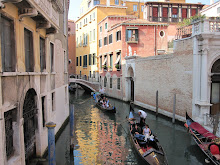
 d picturesqueness. During my visit in late November, I found plenty of stillness and solitude throughout the town, but I suspect that Assisi is often filled with visitors in the summertime because there is a fair amount of infrastructure for it. While tourists may fill much of the area, stillness is also aided by the fact that there are many many public paths and spaces, and everywhere you look there seems to be another staircase or winding street that can provide isolation from fellow humans. As for non-utility, Assisi is a medieval hill town with walls and a castle; cars seem to have a very difficult time navigating the city and tourism seems to be the lifeblood of the economy, as all the shops seem to be selling crafts, souvenirs, or cafe food. People who actually live up there no doubt do so for the beauty of the city and do all their important economic transactions in the town near the rail road station. To add to this, the city seems entirely focused on preserving everything medieval and in fact has a huge medieval fair in May when the entire city wears medieval clothing, hides the cars, and has a huge festival. While in this respect Assisi seems more "dead" than Venice, I am not so sure that is the case because Assisi has been a site of pilgrimage for over 700 years. As such, visitors are a huge part of the town's e
 xistence and thus the preponderence of crafts and religious or decorative shops is merely akin to the preponderance of shipyards in Hong Kong or grain silos in a Midwestern small town. It has the "natural" resource of St. Frances and remains afloat using that. Also, it seems like there is much genuine agriculture in the surrounding valley and that the town tries to preserve itself from too much tourism by preventing the building of too much sprawling tourist infrastructure. While Venice is overwhelmed by kitsch everywhere, Assisi manages to keep that sort of thing confined to around the train station. There is a strong sense of aesthetic saturation everywhere in Assisi, and spiritual saturation for some. Of course, this is highly connected to the fact that Assisi is extremely picturesque. The whole place is such a perfect example of the picturesque it almost seems fake.
 We descended from the castle and walked through the town to arrive at the Basilica of St. Frances. It is a large church and monastery/convent complex built into the hillside, and is beautifully proportioned on the outside. It is actually two churches, one on top of the other. Inside the upper church, it is clearly Gothic with ribbed ceilings and stained glass. The ribs of the ceiling branch out from the massive columns like water from a fountain, and the walls throughout the upper church are covered with frescoes by Giotto. The transepts and apse are enclosed by the most exquisite woodwork, ornate Gothic choir seats. Going down some stairs in the transepts, one comes to a huge courtyard for the monastery.
The lower church is also fantastically beautiful. The ceilings are arched and covered in frescoes of stars on a blue background. There are multitudes of frescoes down here too, and many smaller stained glass windows. Down some more stairs is the tomb of St. Frances. It is in a simple stone chapel and is a simple sepulcher. There were many people praying in here. Some of St. Frances's relics were contained in a nearby room.
The signs outside the church prohibit taking pictures and request silence and respect, but tourists inside were openly talking and taking pictures all over the place. There were even people walking up to St. Frances's tomb and taking pictures of it with their cell phones. This was a sacred space for religious people, and yet some were abusing their privilege of being there, as if this site of pilgrimage were an amusement park. There was a gift shop in the courtyard with art books and religious things, but also postcards and souvenirs. I wondered how the monks viewed the tourists and the irreligious people just seeing sights. I thought the presence of tour groups, souvenirs, and disrespectful behavior nearly destroyed the sacred nature of the place. Nevertheless, the power of the place won over the annoyance of tourists, and that church is the most beautiful and wonderful church I have ever seen in my life.

After exiting the church, we split up for a bit. I went back up to the castle where some rowdy American high school students bothered by antitourist appreciation of the place and caused me to go to the far tower at the end of a long wall, which actually had a better view. After this we visited the Basilica of St. Clare, which was rather plain except for an elaborate marble monument in the crypt. There were some relics down there, and an odd tomb for the saint, with a wax model of St. Clare on top of the coffin. We wandered around the city a bit and noticed an escalator to take tourists from a bus parking lot up a small hill to the city gate. I found it patently ridiculous and demeaning to the place.
 We decided to descend the hill to find another church Lizzie wanted to see. We went down a paved pedestrian path through olive groves and little stone chapels and houses. We were alone on the path except for a local man and his white dog that kept rushing into the groves playing and sniffing things. It was so picturesque and so wonderful. I felt like I walked into a scene on the label of an olive oil bottle. We leisurely took our time and enjoyed the scenery, but as we neared the bottom we saw a tour group descending behind us and the romantic magic of the place was destroyed. Assisi is clearly meant to be enjoyed by the romantic tourist, so I do not understand at all why anyone would want to come in a tour group. The church Lizzie wanted to see turned out to be a convent (cool but not notable after the rest of Assisi) and was surrounded by tourists lazing about.
We decided to walk to a bus stop at the very bottom of the hill a
 nd thus get off the beaten path. It was a beautiful walk. We passed olive groves, vineyards, and fallow fields as the terrain leveled out, and I found the spot where my postcard picture was taken (albiet without sunflowers). Assisi was beaufiul up on the hill, especially in the light of the setting sun. Sadly, we passed a few tourists walking on the same road, but I actually felt a little better because I didn't feel like I was trespassing into somebody's front yard; I was commonplace and just an annoying fact of life. We caught the bus and made it back to the trainstation in time for our long ride back to San Servolo.